Where does my controller break?
A flight controller that tracks well in calm air tells you little about the gust that knocks it off its path. This example finds that gust. It sweeps a simulated 27 g quadrotor through wind gusts with Prove and reads off, direction by direction, the gust speed at which half of its flights crash. That speed is v50, and the set of them is a boundary map.
The drone, the gusts and the seeds are the ones behind Where does a trained drone controller break?, and the code is that study’s public repository, so the map you draw sits beside the maps it stored. You run it from a clone. There is nothing to pip install and no account to make.
Everything here is in simulation: one drone model, one air model, one trajectory and these gusts. A speed in m/s does not carry to a real drone, which is why every speed is printed with a flat force ratio.
1. Clone the repository and set it up
Section titled “1. Clone the repository and set it up”You need Python 3.11, uv and git. The clone is about 200 MB, most of it the study’s stored flights.
git clone https://github.com/poisson-labs/drone-robustness-post1cd drone-robustness-post1uv syncuv sync builds an environment from the repository’s lock file: the simulation stack, the two
classical controllers, MuJoCo and Prove at the version that produced the study’s numbers.
2. Sweep the PID
Section titled “2. Sweep the PID”The example is one script. --quick flies two gust directions, a headwind and a tailwind, at 11
gust speeds and two gust timings, 24 flights each: 1,056 flights, about five minutes on two cores.
uv run python examples/where-does-my-controller-break/where_does_my_controller_break.py --flyer pid --quick --jobs 2Output15 lines · exit 0
cascaded PID: 2 directions x 11 speeds x 2 timings = 44 cells, 24 episodes each, 1,056 episodes; store examples/where-does-my-controller-break/prove-store
Beside the study's stored counts (N1 of RESULTS-P1.md db173c86fbcf): 44 of 44 cells have the same crash count; the counts differ by 0 episodes in all, of 1,056.
direction       v50, m/s                                timing 0  timing 0.125  PID     16 policies, lowest to highest    storedaz 0° el 0°      9.24                                   9.60      9.00          9.24    8.09 to 9.71                      9.24az 180° el 0°   10.16                                   9.09      11.04         10.16   11.00 to 12.50                    10.16
crashes of episodes at each speed, both timings pooled (speed m/s · flat force ratio):                2·0.03    3·0.06    4·0.09    5·0.13    6·0.17    7·0.22    8·0.28    10·0.41   12·0.57   14·0.75   16·0.95az 0° el 0°     0/48      0/48      0/48      0/48      0/48      0/48      1/48      38/48     48/48     48/48     48/48az 180° el 0°   0/48      0/48      0/48      0/48      0/48      0/48      0/48      22/48     47/48     48/48     48/48
wrote examples/where-does-my-controller-break/boundary-pid.svg and examples/where-does-my-controller-break/boundary-pid.jsonIn simulation: one drone model, one air model, one trajectory, these gusts. 24 episodes a cell cannot show a direction is safe.
The PID holds a headwind to 9.24 m/s and a tailwind to 10.16 m/s, and those are the study’s numbers to the digit. Prove derives each flight’s seed from the gust and a fixed salt, so flight 0 of a gust here starts where the study’s did and meets the same turbulence and the same sensor noise. A controller with no network in it is deterministic on top of that, so all 44 of your crash counts are the study’s.
The tailwind’s two timings disagree: 9.09 m/s when the gust peaks at the path’s fastest point and 11.04 m/s when it peaks in the tightest part of a lobe. Pooled, they give 10.16. A pooled number can hide a controller that is fine at one moment of its path and fragile at another, so the script prints all three.
The script also writes boundary-pid.svg beside itself: your two points on a map with the
study’s PID and each of its sixteen trained policies.
3. Check your flights against the study’s, row by row
Section titled “3. Check your flights against the study’s, row by row”uv run python examples/where-does-my-controller-break/compare_with_study.py --flyer pidOutput5 lines · exit 0
where-pid-az0-el0: 528 of 528 rows equal to the study's on every fieldwhere-pid-az180-el0: 528 of 528 rows equal to the study's on every field
pid: 1056 of 1056 rows equal on every field; 1056 of 1056 with the same outcomeevery field equal
Every one of the 1,056 flights you flew equals the study’s stored flight on every field: how it ended and when, each crash rule’s first crossing, the tracking error and the rotor effort.
4. Sweep your own controller
Section titled “4. Sweep your own controller”A controller is a class with reset() and act(view). It reads the same noisy, delayed state
every flyer gets and returns a thrust and three body rates. The rate loop, the mixer and the
motors are the study’s, the same for every flyer. my_controller.py is a stand-in for yours: the
study’s geometric controller with softer gains.
"""Your own controller, as a Prove target:
    uv run python examples/where-does-my-controller-break/where_does_my_controller_break.py --flyer my_controller:rollout --quick --jobs 2
A controller is a class with `reset()` and `act(view)`. `view.reading` is the noisy, delayed state every flyer gets at100 Hz (position, velocity, rotation, body rate), and `view.reference` is the path's next five points, 0.1 s apart. `act`returns a collective thrust in newtons and three body rates in rad/s; the study's rate loop, mixer and motors do the rest,the same for every flyer. See `drone_study.stack.Controller` and `ControllerView`.
This one is a stand-in for yours: the study's geometric controller with softer gains than the study picked. Replace it."""from drone_study.controllers import GeometricController, GeometricGainsfrom drone_study.rollout import rollout_for
rollout = rollout_for(GeometricController(GeometricGains(kp=6.0, kv=3.5, ki=2.0)))
Name it to the script as module:name.
uv run python examples/where-does-my-controller-break/where_does_my_controller_break.py --flyer my_controller:rollout --quick --jobs 2Output13 lines · exit 0
my_controller:rollout: 2 directions x 11 speeds x 2 timings = 44 cells, 24 episodes each, 1,056 episodes; store examples/where-does-my-controller-break/prove-store
direction       v50, m/s                                timing 0  timing 0.125  PID     16 policies, lowest to highestaz 0° el 0°      7.45                                   7.50      7.39          9.24    8.09 to 9.71az 180° el 0°    7.50                                   6.79      8.29          10.16   11.00 to 12.50
crashes of episodes at each speed, both timings pooled (speed m/s · flat force ratio):                2·0.03    3·0.06    4·0.09    5·0.13    6·0.17    7·0.22    8·0.28    10·0.41   12·0.57   14·0.75   16·0.95az 0° el 0°     0/48      0/48      0/48      0/48      0/48      6/48      46/48     48/48     48/48     48/48     48/48az 180° el 0°   0/48      0/48      0/48      0/48      1/48      15/48     33/48     48/48     48/48     48/48     48/48
wrote examples/where-does-my-controller-break/boundary-my_controller-rollout.svg and examples/where-does-my-controller-break/boundary-my_controller-rollout.jsonIn simulation: one drone model, one air model, one trajectory, these gusts. 24 episodes a cell cannot show a direction is safe.
With those gains it breaks near 7.5 m/s in both directions, 1.8 m/s below the PID in a headwind and below every one of the sixteen policies.
5. Change it and sweep again
Section titled “5. Change it and sweep again”Open my_controller.py and stiffen the gains.
diff --git a/examples/where-does-my-controller-break/my_controller.py b/examples/where-does-my-controller-break/my_controller.pyindex d4d9778..27aae76 100644--- a/examples/where-does-my-controller-break/my_controller.py+++ b/examples/where-does-my-controller-break/my_controller.py@@ -12,4 +12,4 @@ This one is a stand-in for yours: the study's geometric controller with softer g from drone_study.controllers import GeometricController, GeometricGains from drone_study.rollout import rollout_for
-rollout = rollout_for(GeometricController(GeometricGains(kp=6.0, kv=3.5, ki=2.0)))+rollout = rollout_for(GeometricController(GeometricGains(kp=12.0, kv=7.0, ki=2.0)))
Then sweep again with a new --store. The script keeps every flight in a Prove store and
looks runs up by the flyer’s name, so a second run under the same name reads what is stored and
flies nothing. That is what makes a repeat instant, and it also means an edited controller run
into the old store prints the old controller’s map. Give each version of your controller its own
store and its own output name.
uv run python examples/where-does-my-controller-break/where_does_my_controller_break.py --flyer my_controller:rollout --quick --jobs 2 --store examples/where-does-my-controller-break/prove-store-stiffer --out examples/where-does-my-controller-break/boundary-stifferOutput13 lines · exit 0
my_controller:rollout: 2 directions x 11 speeds x 2 timings = 44 cells, 24 episodes each, 1,056 episodes; store examples/where-does-my-controller-break/prove-store-stiffer
direction       v50, m/s                                timing 0  timing 0.125  PID     16 policies, lowest to highestaz 0° el 0°      9.45                                   9.26      9.71          9.24    8.09 to 9.71az 180° el 0°   11.02                                   11.09     10.96         10.16   11.00 to 12.50
crashes of episodes at each speed, both timings pooled (speed m/s · flat force ratio):                2·0.03    3·0.06    4·0.09    5·0.13    6·0.17    7·0.22    8·0.28    10·0.41   12·0.57   14·0.75   16·0.95az 0° el 0°     0/48      0/48      0/48      0/48      0/48      0/48      0/48      33/48     48/48     48/48     48/48az 180° el 0°   0/48      0/48      0/48      0/48      0/48      0/48      0/48      1/48      46/48     48/48     48/48
wrote examples/where-does-my-controller-break/boundary-stiffer.svg and examples/where-does-my-controller-break/boundary-stiffer.jsonIn simulation: one drone model, one air model, one trajectory, these gusts. 24 episodes a cell cannot show a direction is safe.
The stiffer controller holds a headwind to 9.45 m/s and a tailwind to 11.02, about 2 m/s and 3.5 m/s past the softer one, and no flight of it crashes at 8 m/s or below. This is the map the script drew for it.
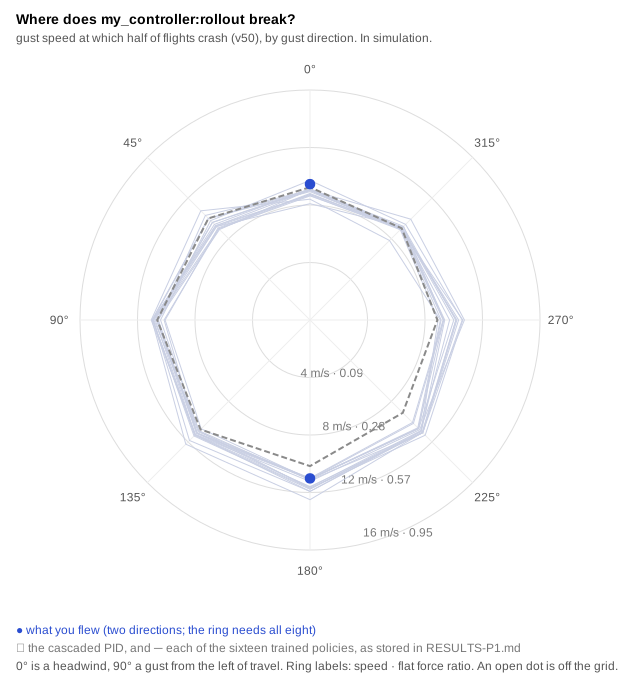
Both versions met the seeds the PID met, gust by gust, so the air was the same for all three. That makes the maps comparable in the plain sense. It does not make 24 flights a test: the counts say where each controller sits, and a claim that one beats another needs a test chosen beforehand and more flights than this.
Going further
Section titled “Going further”- Without
--quickthe script flies the eight level directions (4,224 flights) and draws a full ring;--allflies the study’s whole grid of sixteen directions.--jobsflies that many directions at once. --flyer geometricflies the study’s geometric controller.--flyer pi0-7flies one of its sixteen trained policies, which needs PyTorch: runuv sync --group gatefirst.- The repository’s README shows how to regenerate every number in the post from the stored flights with one command.
What this can and cannot tell you
Section titled “What this can and cannot tell you”- It is a simulation of one small drone under one air model. Above about 6 m/s of airspeed that air model is an extrapolation.
- Twenty-four flights a gust cannot show that a direction is safe.
- One trajectory, two gust timings. A different path is a different map.
- The two classical controllers are two designs with stated settings, and the trained policies never met wind in training. Where they sit beside each other says nothing about learned and classical control in general.
Stored output
Section titled “Stored output”Every output above is what the command printed on a fresh clone of the repository at commit
4b7d0e7, stored in the site repository under src/data/examples/where-does-my-controller-break/
with the three result files the script wrote. my_controller.py is stored there too, byte for
byte as the repository gives it at that commit, with its sha256. The page cannot show an output
that is not there.
One thing is changed in those outputs. The script prints the store’s path and the paths of the files it wrote in full, so on your machine they begin with wherever you cloned the repository. Here they are shown from the clone’s root. The same steps run again on a fresh clone on 2026-11-12 printed the same lines otherwise, and wrote the same three result files.