Prove tells you whether a change to an AI agent really changed how often it fails.
It replays the same cases before and after the change, on the same seeds, and compares
the two runs condition by condition. The verdict is safer,
worse, trade or no significant change, with stated
error bounds and detection limits.
It works alongside the tracer and the test runner you already have, uses no model to
grade your agent, and needs no hosted account.
When no change counted and at least one condition could not have shown a change of the
size you accept, the verdict is too small to tell instead. Before a sweep
runs, its plan refuses a design that small and names the number of replicates that would
do.
Poisson Prove 0.1.0, 41 seconds, no sound. The video’s text
0:00$ pip install poisson-prove · poisson labs · prove 0.1.0 · Evals give you a score. Prove tells you what changed. · Same cases, same seeds, before and after a change. · A verdict per condition, and what it couldn't detect.
0:06Same agent. Same config. Same seeds. · It scored 45.0%, then 44.0%. · 44 of 200 tasks flipped. · τ²-bench airline · two runs back to back · one square per matched task, lit where the outcome flipped
0:12Poisson Prove · Find out what a change actually did. · Condition by condition: what got better, what got worse, what the run couldn't detect.
0:16compare: same conditions, same seeds, before and after · test: a paired test per condition, corrected across all of them · verdict: safer, worse, or no significant change · limit: the smallest change each condition could have caught · setup: your coding agent writes the adapter
0:21Fall rate by condition, before and after a retrain · Microduck walking policy · checkpoint 2250 → 5999 100 rollouts per condition, same seeds · falls, all 14 conditions: 0.505 → 0.208 · 8 safer · 5 worse · 1 no significant change · push 0.600 · friction 0.6: 0 → 16 of 100, worse · the unmoved one could have caught a rise of 0.123 · Better on average. Worse in 5 of 14 conditions. · paired test on shared seeds · Holm over 14 tests, 0.05
0:30Prove tells you when a gap is too small to tell. · HAL · 9 agent benchmarks · neighbouring ranks on the tasks they share · exact paired test, BH per benchmark, as published · AssistantBench: 0 of 29 · CORE-Bench Hard: 0 of 55 · GAIA: 0 of 33 · Online-Mind2Web: 0 of 22 · SciCode: 0 of 36 · ScienceAgentBench: 0 of 24 · SWE-bench Verified Mini: 0 of 25 · τ-bench Airline: 0 of 41 · USACO: 3 of 13 · 3 of 278 neighbouring pairs can be told apart.
The example sweeps a mock agent, then a patched version of it on the same seeds, and
compares the two. --yes answers the question each sweep asks after its plan.
The first run
The example reads trade.
$ poisson-prove diff
trade  timeout: … safer, … worse · violated: … safer, … worse (paired test
       on shared seeds); …
  method  paired test on shared seeds (McNemar), the default for runs
          paired at sweep time
  before  mock-agent <date> a
  after  mock-agent <date> b
  trade  …: violated fell, timeout rose
  verdict rule  …
  limits  …
  intervals  …
  fragility  …
…
  next: poisson-prove report --x task_id --y tool_fail_rate
trade means some conditions got safer and at least one got worse. The
patched agent takes a forbidden fallback (violated) less often, and in one
condition where tools fail most it runs out of tool calls (timeout) more
often. Under the
word, diff names the test, the two runs, the conditions that traded, the
rule the word was decided by, each condition's detection limit, and an interval on each
change. The next: line is the command to run next, whole.
The mock agent is a fixture for learning the commands, and its numbers measure nothing.
They also move from one pair of sweeps to the next, so this page shows the verdict and
the shape of the output and leaves the counts out.
How it works
Sweep
Every condition, many times, each episode on its own seed. A sweep after the change,
paired with the first, gets the same seeds, so each episode is compared with its twin.
Compare
A test per condition and outcome. The flags are held to a false discovery rate
(Benjamini–Hochberg), and the verdict counts only the changes that also hold at the
family-wise level (Holm).
State the limit
Every condition that did not move says how large a change it would have caught 4
times in 5, computed for the test the comparison used, or that it could not have caught
one at all.
One condition and one seed in, an outcome and a time out. support_bot
stands for your own agent.
Set up by your coding agent
init --agent writes a skill for your coding agent, which writes the setup for you to review.
$ poisson-prove init --agent
ok  wrote the setup for your coding agent (4 files)
  wrote  .agents/skills/poisson-prove-setup/SKILL.md
  wrote  .agents/skills/poisson-prove-setup/prompt.txt
  wrote  .claude/skills/poisson-prove-setup/SKILL.md
  wrote  .claude/skills/poisson-prove-setup/prompt.txt
  prompt  Use the poisson-prove-setup skill in this repository: set
          Poisson Prove up for me to review, then stop.
  next: give your coding agent the prompt above, then review what it
        wrote
The skill is written where Claude Code, Codex and Cursor look for skills. Given the
prompt, your agent reads
your code, writes prove_rollout.py and prove.toml, checks them
with poisson-prove sweep --dry-run, which runs no episode, and stops with
a list of what you need to confirm. You run the sweep yourself.
Prove makes no model call and reads no key. The coding agent is yours, and so is
whatever it costs to run.
The terminal app and the dashboard
The terminal app and the dashboard read the same store.
poisson-prove with no verb, on a terminal, opens the terminal app: your
runs, your comparisons and their verdicts, a sweep of the folder's
prove.toml, and every condition and episode behind a verdict, all by keys.
Every number on its screens is the one the commands print.
$ poisson-prove ui
ok  dashboard at file:///…/prove-runs/.poisson/ui/index.html
poisson-prove ui builds the dashboard: pages over the store that you open
from disk, with nothing served and nothing loaded from the network. They show the
runs, each comparison saved by report, serve or
diff --save with its verdict and charts, each condition, and the episodes
behind an outcome. In 0.1.0 the pages are static: once built, they are rebuilt by the
commands that write to the store, and a page shows the store as it was when it was
built.
Next: a live local dashboard over the same store, then setting up and running sweeps
from either the terminal app or the dashboard.
The terminal app, at 80 × 24
HomeAs text
poisson-prove · home                                                  prove-runs
────────────────────────────────────────────────────────────────────────────────
  ok  2 runs and 1 saved comparison in prove-runs

  latest     mock-agent 2026-10-29 b (complete, paired with "mock-agent
             2026-10-29 a")
  compared   mock-agent 2026-10-29 a → b: trade
  next       poisson-prove report --x task_id --y tool_fail_rate
  dashboard  index.html

  kind        name                         result     rows  created
› comparison  mock-agent 2026-10-29 a → b  trade            2026-10-29 19:54Z
  run         mock-agent 2026-10-29 b      complete  1,746  2026-10-29 19:45Z
  run         mock-agent 2026-10-29 a      complete  1,746  2026-10-29 19:45Z


────────────────────────────────────────────────────────────────────────────────
  ↑↓   enter   tab links   s sweep   c compare   r runs   y   ? help   q quit
The comparisonAs text
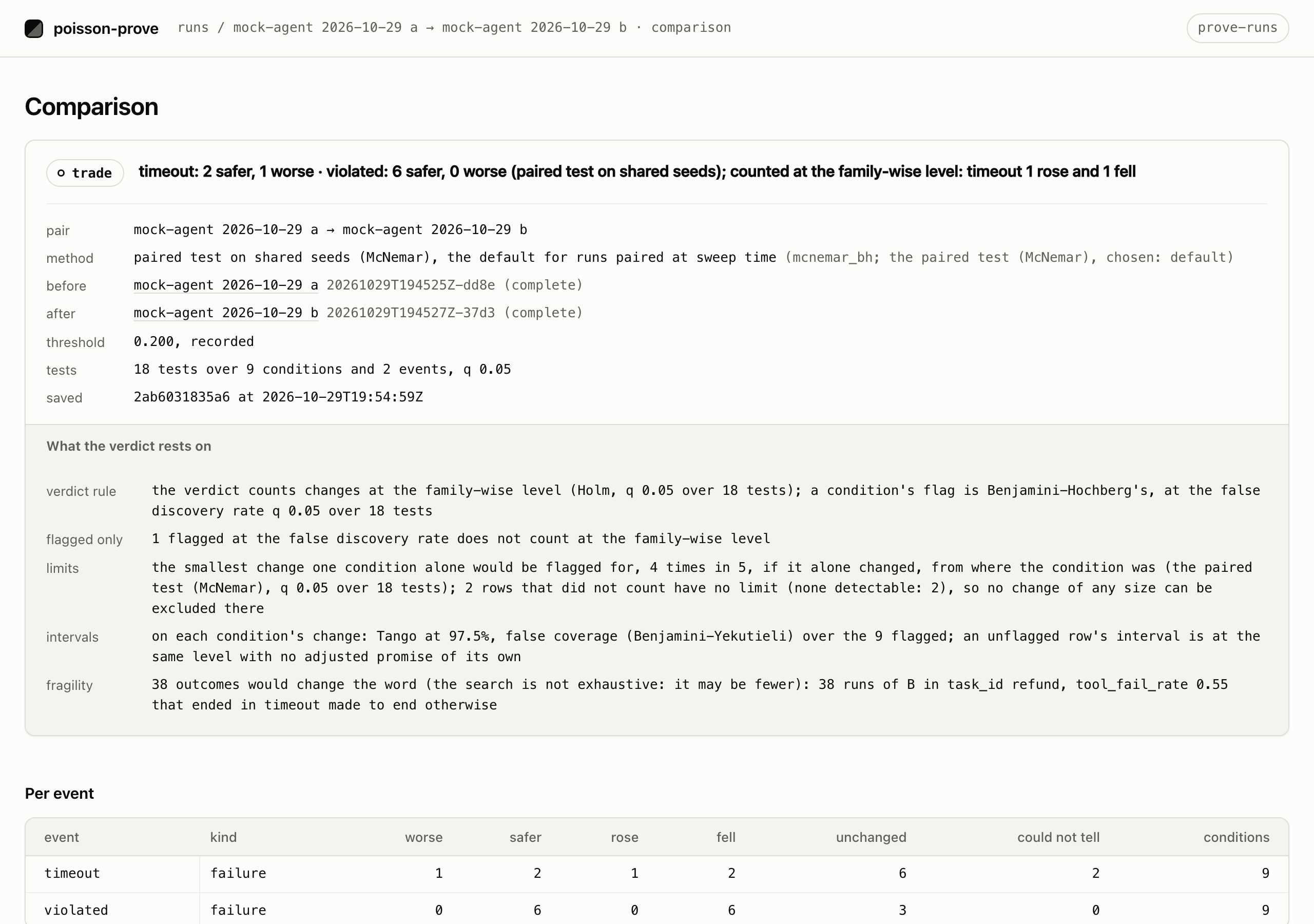
poisson-prove · comparison  mock-agent 2026-10-29 a → b               prove-runs
────────────────────────────────────────────────────────────────────────────────
  trade  timeout: 2 safer, 1 worse · violated: 6 safer, 0 worse (paired test on
         shared seeds); counted at the family-wise level: timeout 1 rose and 1
         fell

  method          paired test on shared seeds (McNemar), the default for runs
                  paired at sweep time
  before          mock-agent 2026-10-29 a (20261029T194525Z-dd8e, complete)
  after           mock-agent 2026-10-29 b (20261029T194527Z-37d3, complete)
  trade           task_id refund · tool_fail_rate 0.55: violated fell, timeout
                  rose
  24 more lines above the table: m shows them
  event     kind     worse  safer  unchanged  could not tell
› timeout   failure      1      2          6               2
  violated  failure      0      6          3               0

  heatmap      comparisons/2ab6031835a6e2f4/heatmap-timeout.html
  differences  comparisons/2ab6031835a6e2f4/differences-timeout.html
  limits       comparisons/2ab6031835a6e2f4/limits-timeout.html


────────────────────────────────────────────────────────────────────────────────
  ↑↓   enter   esc   t conditions   d   tab   y   m   ? help   q quit
A conditionAs text
poisson-prove · condition  task_id refund · tool_fail_rate 0.55       prove-runs
────────────────────────────────────────────────────────────────────────────────
  worse  timeout rose from 0.139 to 0.469 (+0.330) (the paired test (McNemar), q
         2.6e-11)
  before  0.139 [0.097, 0.195], 27 of 194 episodes
  after   0.469 [0.400, 0.539], 91 of 194 episodes
          95% Wilson interval on each run's share, per condition, not adjusted
  change  +0.330 [+0.228, +0.426], 97.5% interval (Tango)
  test    the paired test (McNemar): 79 pairs had timeout only after, 15 only
          before; p 1.2e-11, q 2.6e-11, Holm's p 1.3e-10, statistic -64
  rise    0.166: the smallest rise one condition alone would be flagged for,
          power 0.800, from the observed baseline (McNemar, level 0.003 over 18
          tests)
  fall    0.109, the same way
  event   timeout, declared a failure; the smallest possible p is 8.0e-59, so a
          flag can be raised
  19 more lines above the table: m shows them
› episodes  before  27 ended in timeout  mock-agent 2026-10-29 a
  episodes  after   91 ended in timeout  mock-agent 2026-10-29 b

  chart  comparisons/2ab6031835a6e2f4/7b806df50938571e/incidence-timeout.html

────────────────────────────────────────────────────────────────────────────────
  ↑↓   enter   esc   e other event   tab links   y copy   m   ? help   q quit
The dashboard
RunsThe comparisonA conditionA chart: the timeout heatmap
One run of the keyless example, from a fresh install: the app drawn from its own terminal
output, the pages as poisson-prove ui wrote them, the top of each. The agent
is a mock, so its counts measure nothing, and they move from one pair of sweeps to the next.
Where it runs, and what leaves your machine
Prove never phones home.
Sweeps run on your machine by default. With pip install "poisson-prove[modal]"
they run in parallel Modal containers on your own Modal account. Given the seconds an
episode takes, the plan estimates the compute cost from Modal's prices before anything
starts, and a cap you set refuses a sweep estimated above it; your model's tokens are
not in the estimate. With pip install "poisson-prove[burla]" they run on
your own Burla cluster, in your own AWS, Google Cloud or Azure account; the extra pins
Burla 1.8.2, and this backend is experimental. Your rollout's code
and conditions go to the account you choose, and the episodes come back to the same
local store.
Beyond the backend you choose, Prove sends nothing anywhere: no telemetry, no
analytics, no update check.
poisson-prove serve listens on 127.0.0.1 only.
What the numbers do not claim
It compares two runs, under the conditions you swept.
no significant change means no change counted, and every condition could
have caught one of the size you accepted. A smaller change can still be there.
Prove does not claim that the change caused anything: it compares two runs. It says
nothing about conditions you did not sweep, and it cannot check that an outcome label
means what you meant by it. It is not a benchmark, an agent framework or an
observability tool, and it never edits your code.
On an agent
+63pp · more often no significant change · blind under 50pp −63pp · less often
1 higher 327 no significant change, 49 of them blind at any size 0 lower coloured only at q<0.05, corrected across every condition
Fig. 1One code agent against itself, nothing changed: 328 conditions,
32 episodes each, McNemar's test per condition. The verdict is
higher: one condition,
HumanEval/129 at 0.7, failed more often, a
problem that broke between the runs. Of the other 327, the weakest that has a
limit could only have detected a 50pp change, and 49 could not
have detected one of any size. This is the floor a real change has to clear.
report.md ·
receipt.html
On a robot policy
+81pp · more often no significant change · blind under 47pp −81pp · less often
baseline fell rate among them · 0% to 100%
0 higher 340 no significant change, 72 of them blind at any size 60 lower coloured only at q<0.05, corrected across every condition
PUSH, % BODYWEIGHT →↑ FRICTION μ32 TRIALS PER CELL PER VERSION
Fig. 2Go1 locomotion, before and after a retrain: 400 conditions,
32 trials each, Fisher's exact test per condition. 60 conditions fell
significantly less often and 0 more often; 34 of the 60 also
hold at the family-wise level, which is what the verdict, lower, counts.
Of the 340 with no significant change, the weakest that has a limit could only
have detected a 47pp change, and 72 could not have detected one
of any size.
report.md ·
receipt.html
+73pp · more often no significant change · blind under 12pp −73pp · less often
baseline fell rate among them · 0% to 100%
5 higher 1 no significant change 8 lower coloured only at q<0.05, corrected across every condition
LATERAL PUSH, m/s →↑ FRICTION μ100 TRIALS PER CELL PER VERSION
Fig. 3A biped at two checkpoints: 14 conditions, 100
trials each, McNemar's test per condition. The verdict is mixed: falls went
down in 8 conditions and up in 5, all 13 at the
family-wise level too, and the one condition with no significant change could have
detected a change of 0.123. The later checkpoint is better under a hard push and worse
under a gentle one, which an average would hide.
report.md ·
receipt.html
2026.09Where a 14-DoF Biped FallsTwo checkpoints of a Microduck walking policy under a lateral push: a cliff and a slope, with a crossover between 0.600 and 0.625 m/s. A retrain meant to widen the boundary was worse in 14 of 14 cells.Microducklocomotionreadreportreceiptretrain report
2026.08Map the Failure BoundaryA Go1 locomotion policy across 400 conditions of floor friction and lateral push. Retrained on the two gaps the map exposed: 60 conditions significantly safer, none worse.Go1locomotionreadreportreceiptcode
Each figure is its study's stored pair compared by Prove 0.1.0, with the test
the study published. The runs were made before outcomes could be declared as failures,
so Prove names the directions lower and higher, and
a comparison with both mixed; for a declared failure it says
safer, worse and trade.
Empirical evidence under a stated test envelope, not formal verification. Conditions
outside the envelope were not tested; conditions inside it can only resolve effects at
or above the reported MDE.
The release
Prove 0.1.0
Released 2026-10-29,
from 3dc29cc,
tagged v0.1.0. Open source, under the MIT licence.